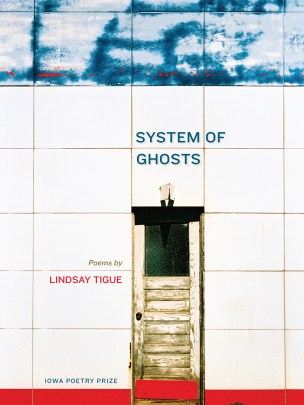
- Winner, Iowa Poetry Prize
- Shortlisted, Julie Suk Award
- Bronze Winner, Foreword INDIES Book Award for Poetry
- Finalist, Eric Hoffer First Horizon Award
- Finalist, Eric Hoffer Award Poetry Category
University of Iowa Press Book Page | Add on Goodreads | Add on StoryGraph
*Reviews of System of Ghosts in: Green Mountains Review, Gulf Coast, storySouth, New Orleans Review, The Gazette, NewPages, The Literary Review, Birmingham Poetry Review, American Book Review, Stirring, Poet Lore
*Selected Press and Interviews: Ploughshares Blog, Lansing City PULSE, Flagpole, Largehearted Boy, The Adroit Journal interview, The Writer’s Center, Sundress Lyric Essentials.
*Poems from this book in: Poetry Daily, Verse Daily, Rattle, Hayden’s Ferry Review, Prairie Schooner, diode, Blackbird, Poet Lore, Indiana Review, The Literary Review
“Lindsay Tigue has, first and foremost, a curious mind: her poems are motored by information. Bits of knowledge, gathered magpie-like, which others might consider trivia–the origins of the red and green on traffic lights, the different ways distant towns told time before railroads connected them, the composition of the asteroid Ceres–spur these poems toward startling personal and public insights. As in the poetry of Robyn Schiff and the prose of Eula Biss, these esoteric facts, knit together carefully and with a gentle sense of mischievous humor, come to generalize about human suffering and hope.”—Craig Morgan Teicher, author of To Keep Love Blurry
“At once a record and a haunting, [Tigue’s] poetry invites us to consider the ways loss shapes us while also demanding we live in the present moment.” —Andrea Scarpino, American Book Review
“I find myself returning to this book again and again, a sincere phantom.”—Jenn Carter, Green Mountains Review
“System of Ghosts explores frontiers vanishing and gone. With a restless intelligence, Lindsay Tigue’s poems seek to know, to measure, to recover histories nearly lost. In these pages the world and the self are fantasized, destroyed, shared like an orange, abandoned like a rough draft, as unforgettable as the dead.”—Traci Brimhall, author of Our Lady of the Ruins
“Lindsay Tigue’s work presents a vision, dominated by geography and natural history, uniquely paired with emotional imagination—the not-there-ness that coexists with its there-ness. This crush together, her feelings always a bit estranged from her, replaced by her gravitation to facts that she has remembered.”—Diane Wakoski, author of Bay of Angels
“I hope other readers will remember the name Lindsay Tigue and find or buy or borrow or read over somebody’s shoulder System of Ghosts.”—Kelly Cherry, StorySouth
“[Lindsay Tigue] insists we are built in some measure by what we lose, what we grieve, that part of being alive is being lonely.”—Molly McCully Brown, author of The Virginia State Colony for Epileptics and Feebleminded, New Orleans Review
“[Tigue’s] readers are also left with a more full-bodied experience than most debut poets achieve. Readers can only look forward to Tigue’s next book with anticipation for the continued attention she will give to living in a world weighted with what has come before.” —Jeremy Michael Reed, Stirring: A Literary Collection
“Tigue knows just how to bring her disparate sources and notions — and the ghosts of the past — together to craft work that gives wider context to the present moment.”—Rob Cline, The Gazette
“In her first book, Tigue has mastered a technique of taking facts. . .and using them as a springboard to wherever her imagination leads her. ” —Valerie Wieland, NewPages
“Ultimately, the strong but understated emotion in Tigue’s poems reminds us that the abandoned places are no longer barren. They are occupied with her presence.”—Dan Chu, poetry editor, Gulf Coast
“Carrying us from ‘abandoned places’ to unexplained losses and unconfirmed sightings, this promising first collection offers a thoughtful, if unsettling, exploration of the Zeitgeist by a poet ‘just / waiting for reasons to measure.'” —Debra Wierenga, Poet Lore
“In many ways, System of Ghosts is a collection about physical dislocation and migrant memory. . . . Lindsay Tigue brings us closer to understanding our own inventions, ruins, emotions, and the lost roots that leave us in despair and solace with the shadows of abandonment, and what they translate into in our psyche.” —Vibha Rana, The Literary Review


You must be logged in to post a comment.